What Is an Autism Monitoring Device? A Complete Guide for Parents
Updated on April 7, 2026Autism monitoring devices are an essential part of modern autism safety and support. For many families, the need for real-time awareness is not optional—it’s critical. Risks such as wandering, combined with communication challenges, mean that caregivers often need a reliable way to know where their child is and how they’re doing at any given moment. Whether it’s a dedicated GPS tracker for autism or a more advanced wearable solution, these tools provide a level of visibility and responsiveness that traditional methods simply can’t match. As a result, more parents are turning to a monitoring device for their autistic child as a proactive way to enhance safety and peace of mind.
At the same time, these technologies are about more than just protection—they are also designed to support independence. By enabling safe exploration and communication tools when they’re needed most, autism monitoring devices help children navigate the world with greater confidence. In this guide, we’ll break down everything you need to know, including the different types of devices available, the key features to look for, the benefits they provide, and how to choose the right solution for your family’s unique needs.
What Is an Autism Monitoring Device?
Autism monitoring devices are tools meant to help caregivers track the wearer’s location, monitor safety, and support communication. What differentiates them is their exclusive design for use by people with autism. Ever since coming on the market during the 2010s, these autism-specific features continue to evolve, including better caregiver alerts, sensory-friendly design, and tailored functionality–all of which we break down for you below.
Comparison to Generic GPS Trackers
Many autism monitoring devices are based on GPS tracking technology. Some parents, therefore, believe that an autism tracking device does basically the same thing as other tracking devices which begs the question – is a different, autism dedicated device really necessary?
Many parents believe a generic GPS tracker will do the job. This is why you’ll see people buying, for example, standard GPS trackers such as Jiobit, ProPod, and Apple’s AirTag, along with a fastener to attach to clothing, and assuming that it will deliver the same functionality if their child wanders.
But that’s not necessarily true. An effective autism monitoring tool must to do more than just monitor (plus, the AirTag is limited because it can only be detected by other Apple devices). A quality autism safety technology delivers critical functions during an emergency. Plus, on a practical, non-emergency level, autism safety devices provide additional supports like communication and a method of promoting wellbeing.
In comparison, generic GPS trackers offer a lower level of function. Let’s define common GPS tracking devices as chips that can be attached to something with a sleeve, clip, pouch, etc. These small devices were designed to track objects and pets–that is, without any interactive functions. The design features that make them practical as generic trackers also take away from their overall usefulness. Here’s a comparison:
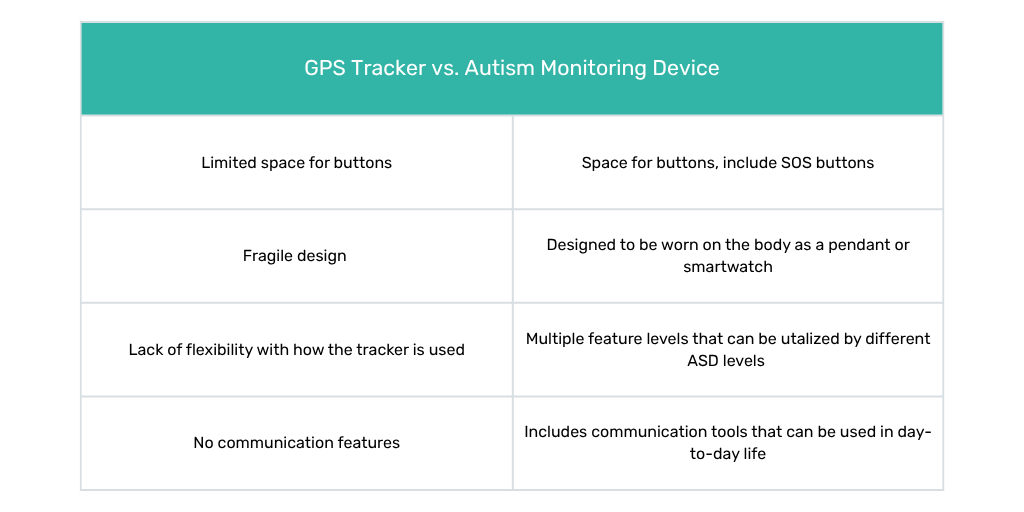
Purpose-built safety devices for autistic children ultimately enable more independence for the user, and peace of mind for the caretaker, which is far beyond the scope of garden-variety tracking devices.
Types of Autism Monitoring Devices
Assuming, then, that standard GPS trackers are not sufficient, people in the assistive autism safety technology market can still choose from a wide range of other devices– each with its unique pros and cons. These are the main categories of today’s monitoring devices:
Home Monitoring Systems
Modern versions of these systems provide a number of useful abilities. In addition to desktop and ceiling mounted cameras, these tools include sensors to detect an open door or window, as well as remote monitoring functions that you can access through a smartphone. Devices like these are vital for making sure that your child is where they are supposed to be, even when you are sleeping or away from home. After all, wandering from the home (or another supervised place) is a major risk for autistic families. However, the coverage of these systems ends at the border of your property.
Smartphones
Common applications such as Life360, Geo Tracker, and even Google Maps all provide tracking features. However, smartphones and apps might be too complex for some autistic people to use because they face challenges related to motor skills. In addition, many of these applications rapidly drain the battery of a mobile phone.
Wearable Devices
These devices are larger than basic trackers because they include communication and emergency features. Plus, because they are bigger, they require a more robust carrying method. Different kinds of clothing, smartwatches, lanyards, and pouches allow the autistic person to carry it conveniently, while some manufacturers supply wearables that hide the device so as not to irritate the wearer’s sensitivities to the device’s shape or material.

Key Features to Look For
Parents seeking a device that strikes a balance between portability, ease-of-use, and practicality often turn to wearables. But how do you know which one is right for your child? These are the most valuable features to look for when considering any device:
- Real-time tracking for autism based on GPS positioning, along with frequent updates that are critical for knowing the exact location of a moving person (i.e. during a wandering event).
- Autism geofencing alerts that proactively let caregivers know if a person has left a certain area; some devices use artificial intelligence to automatically set the area’s borders.
- SOS buttons as one-touch emergency measures, which can be activated even by people with severe physical limitations.
- Autism communication features that effectively turn the monitor into a phone as well. Two-way conversations can be augmented by auto-pick up devices that enable one-way initiation, where the autistic person does not have to actually answer a call.
- Caregiver apps that leverage real-time tracking to see where the device wearer is on the map, along with useful additions such as location sharing with other caregivers, school authorities, and first responders.
- Indoor tracking that complements GPS-based autism wandering prevention; when a GPS signal is disrupted by the device being indoors, it can be replaced by local Bluetooth and WiFi.
- Battery life that is extended by, for example, the device going into “hibernation” if the wearer is not moving, or by the use of high-quality batteries.
- Durability offered by devices that are built to withstand physical shock and moisture; common materials include thick plastic and rubberized casing.
- Wearable autism devices with a sensory-friendly design to reduce the chance that the wearer will remove it; options include specific materials, rounded shapes, and the ability to place the device where the user cannot remove it easily.
Choosing the Right Device for Your Child
With all of these specifications in mind, how do you pick the autism monitoring device that’s best for your child? Like many things related to ASD, a lot depends on where they are on the spectrum. Each individual has their own unique characteristics, preferences, weaknesses, and abilities. Your selection should reflect all of these facts. Here are some helpful questions to think about when making your choice:
- The older your child is, the more likely that they will have both the need and capability to use autism tracking. For instance, older kids often travel on the bus to school, making monitoring essential.
- Think about your child’s daily environment: Do they go outside a lot? Do you live near water? Is your home in a crowded city, where it’s easy to get lost? All of these factors will affect your choice.
- Some people with autism are non-verbal, while others are very verbal. If your child has difficulty in communicating, a device with communication features is highly practical.
- How independent is your child? Some children might be, for instance, at a level three autism, non-verbal, and under constant supervision. A child like this might do well with a simpler device – although the risk of autistic wandering is always present, even for children who are never out of a caretaker’s sight.
- Many autistic people have sensory processing disorder and might dislike the shape, fabric, or simple presence of a device. The better device suppliers provide a wide range of wearing solutions that address almost every sensitivity.
Still uncertain? Fortunately, some autism monitoring device suppliers offer trial periods so that you can get practical experience in its use. In addition, you can involve your child in the decision, as they might like the features or appearance of a certain product. Finally, the top manufacturers often upgrade devices and software so that their benefits increase frequently. Simply take a look at their websites, where new releases are announced (and you can get a sense of how often they upgrade/release new features).
Benefits for Safety and Independence
It might feel like work to find the best device, but the effort is well worth it. As we share below, there are countless anecdotes where this technology has literally saved lives. Through functions like automatic geofence alerts, real-time tracking, and easy communication with first responders, monitoring devices improve response time during emergencies and reduce wandering dangers.
Autism monitors are also valuable as a form of everyday assistive technology. Leading suppliers have added to their devices’ usefulness as tracking and safety applications through tools like voice and text communication, wellbeing features like step counters and pill reminders, and integration with school administrators.
With the right device, autistic children enjoy greater freedom to live a relatively independent life. In turn, families and caregivers can be more relaxed when their loved one is out of sight, with the confidence that they can act immediately and effectively in case of trouble.

When and Where these Devices Are Most Helpful
There is no shortage of real-life use cases that illustrate the life-saving qualities of autism monitoring devices. Here are just a few:
- The prevention of sexual assault against a 15-year-old girl out for a walk
- Rapid location of a non-verbal 8-year-old boy who was dropped off at a wrong location by a bus
- Finding an autistic child who had decided to hide somewhere in his school
- Calling an autistic boy to keep him calm during a violent school lockdown
- Tracking a young boy who had eloped from his home during a moment when his mother was distracted
What do all of these incidents have in common? They were all resolved by AngelSense, a leading assistive technology for people with autism. AngelSense has outstanding tracking and emergency features, backed up by powerful tools for everyday living. With these life-saving and life-supporting features, it’s clear why AngelSense is a market leader for families living with autism seeking a comprehensive solution that delivers peace of mind.
Privacy, Ethics, and Responsible Use
One issue that parents also raise is that of privacy and other ethical concerns. For instance:
Is it legal to track a child?
In almost every case, it is legal for a parent or guardian to track their child. Once that child turns 18, this right can change, depending on the person’s level of independence. At that age, it’s simply a matter of getting an autistic adult’s permission.
Will an autism tracker violate school policy?
There are cases where features like communication tools (e.g. mobile phone capability) will not be allowed, particularly during class time. But some devices, like AngelSense, provide a way to temporarily disable this feature by administrators.
Does such a device threaten my privacy?
Like any digital device, autism trackers can be hacked, while some users fear that voice communications will be recorded. That’s why you should choose a supplier with strong data privacy policies that, for example, encrypt your information and block the recording of calls by a third party.

Supporting Safety without Limiting Independence
Autism monitoring devices are ultimately tools designed to support—not restrict—autistic individuals. When used thoughtfully, they create a balance between safety and independence, allowing children to explore their surroundings while caregivers remain informed and ready to respond if needed. Rather than limiting freedom, a well-chosen device can reduce risk, ease daily challenges, and provide a reliable connection in both routine moments and unexpected situations.
These devices become part of a broader strategy that promotes confidence, communication, and quality of life. Families who integrate them into everyday routines often find that they offer not only protection, but also peace of mind and greater independence for their child. In the end, the goal is simple: to empower autistic individuals to move through the world more safely and confidently, with the support they need always within reach.
Get peace of mind from AngelSense, the groundbreaking AI-based assistive technology designed to enhance safety and peace of mind for individuals with special needs and their families. Our solution ensures you stay connected with your loved ones, empowering a higher level of independence while maintaining safety. Learn more about how AngelSense can make a difference for your family.